




Custom Coffee Bags | Flat Bottom & Compostable


Custom Coffee Bags – Specifications
| Brand | BIOPOUCHES |
| Structure | Flat bottom bag with side gussets |
| Materials | Compostable film (final structure subject to confirmation) |
| Thickness | 130–175 microns |
| Sizes | Custom width × height × bottom depth |
| Printing | Custom gravure printing |
| Finishes | Custom surface finish, subject to material compatibility |
| Closure | Resealable zipper; one-way degassing valve option |
| Applications | Whole-bean and ground coffee packaging |
| Quality Checks | Dimensions, printing, seals, zipper and valve installation where applicable |
| Production | Shanghai |
| Offices | Shanghai · Canada · Indonesia |
| Customization | Size, materials, artwork, printing, zipper and valve requirements |
Listed MOQ: 1,000 pieces. Final material structure, dimensions, valve compatibility and compostability documentation are confirmed during technical review and sample approval.
BIOPOUCHES manufactures custom coffee bags for roasters, private-label coffee companies and established coffee brands. This page covers flat bottom bags with printed artwork, a choice of material structure and a resealable closure, with a one-way degassing valve added when the coffee needs it.
What Roasted Coffee Needs From Its Packaging
Oxygen is the main concern. It contributes to the loss of aroma and flavor, and it can get in through the film, the seals, the closure and any added component. No bag has zero oxygen transmission. Moisture protection depends on the film structure and storage, and films differ. Opaque structures and printed films can reduce light exposure, depending on how they are built. Not every custom bag is fully light-blocking.
Then there is degassing. Freshly roasted coffee releases carbon dioxide for a period after roasting, and a bag sealed straight away can swell. A one-way valve gives that gas a way out while limiting outside air coming in. Whole bean coffee generally releases gas more slowly than ground coffee, which loses much of it during grinding. Whether you need a valve depends on the product and on how soon after roasting you pack.
One-Way Degassing Valves: From Hole Position to Finished Pouch
First we agree with you whether a valve is needed, which type, and where it goes. The position has to work with the artwork, the filling level, the folds and the final sealing areas.
Where the valve system needs an opening in the film, the hole is punched at the agreed spot during production. The factory has a valve punching operation for this. A hole off position puts the valve onto artwork or near a seal, and a ragged edge leaves damaged film around it.
Valve systems are attached in different ways, so the method has to suit the valve and the film.
Inspection then looks at valve position, orientation, attachment quality, the surrounding film and any possible leakage path. That checks the attachment. The valve's one-way function, when it opens and how well it limits air coming back in, depends on the valve design and the finished package. It is a separate question.
Flat Bottom Design and Sizing
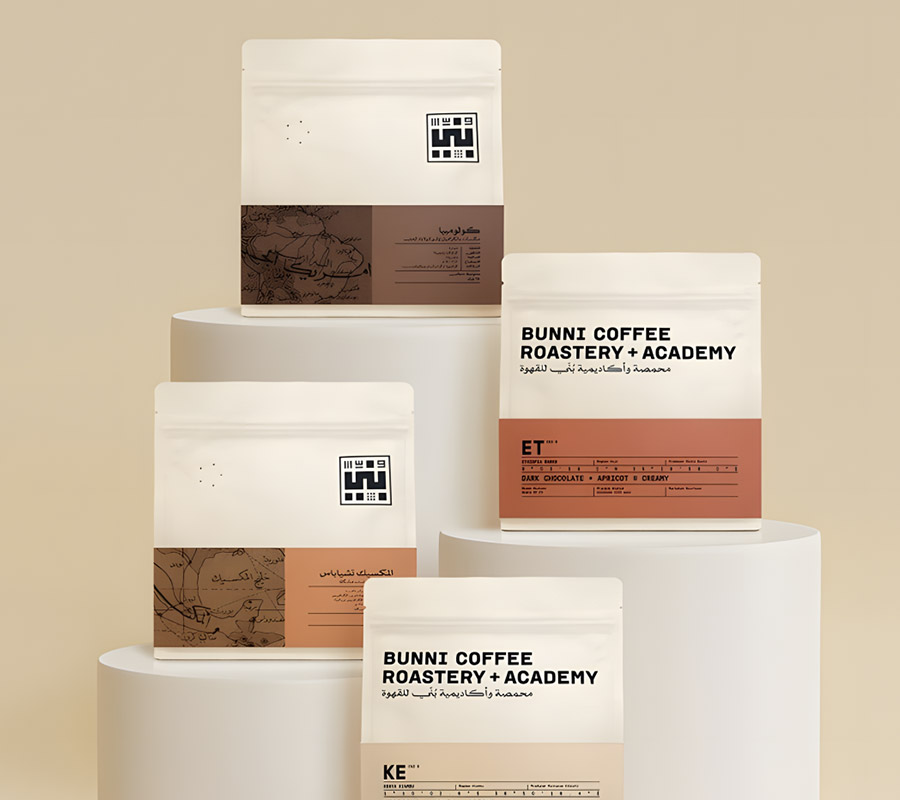
A flat bottom coffee bag has a rectangular base and side gussets, so the filled bag holds a squared shape. The front and back carry the main artwork, and the side panels suit brand or product information. Dimensions are custom, but the zipper, the valve and the top seal allowance all take space, so the bag is sized around them as well as the coffee.
Target weight alone does not set the size. Usable volume depends on the coffee, its bulk density, the bag geometry and the filling method. How well a filled bag stands also depends on the fill and the folds. A physical sample and a filling trial before bulk production answer both questions.
How Custom Coffee Bags Are Made
The approved film structure comes first, and it has to match the coffee's protection needs and the bag format. Gravure and digital printing are both available. The factory has a 10-color gravure press for multi-color designs, though not every bag uses ten colors. Registration has to hold across the front, back, side gussets, folds and seal zones. Where the structure is laminated, the printed layer is combined with functional layers, and lamination quality affects forming and sealing. Printed film is inspected before conversion for registration, visible defects and consistency.
Forming sets the base, gussets and final dimensions, and valve punching and attachment happen at this stage. Sealing parameters and cutting accuracy then decide whether the seals hold and the dimensions repeat from bag to bag. Finished bags are checked for appearance, dimensions, folds, seal condition, zipper operation where fitted and valve placement where fitted. Not every order uses every step. See the equipment in our factory and testing photographs, and printing is covered in our article on the flexible packaging printing process.
Production Controls and Laboratory Testing
Production SOPs keep these steps repeatable. Before production, we review the approved artwork, material structure, dimensions, closure and valve location. During production, setup and process parameters are monitored for printing, forming, sealing and valve attachment. Finished bags are inspected for dimensions, appearance, closure function and visible defects against the approved specification. Equipment is cleaned daily. The approved sample confirms design and construction, and bulk inspection checks that the run keeps matching it.
The lab has a heat-seal tester, an electronic tensile tester, a coefficient-of-friction tester, a seal-integrity or leak tester and a temperature-controlled oven. The heat-seal tester makes sample seals at a chosen temperature, pressure and contact time to show how a material seals. With the right specimen and method, the tensile tester measures seal-peel strength, which tells you more than looking at a seal. Leak testing looks for leakage paths under defined conditions, but passing it does not establish an oxygen transmission rate or shelf life. Friction testing shows how film moves through packaging equipment, with no guarantee of fit with every machine. The oven supports evaluations at controlled temperatures.
Which tests apply depends on the film, the valve, the sealing process and your filling conditions. No OTR, WVTR, valve opening pressure, seal strength or shelf-life figure is published for this product.
Compostable, Recyclable and High-Barrier Options
Compostable packaging needs a defined material structure and compostability evidence for that structure. Recyclable mono-material packaging is built around compatible materials and relies on recycling infrastructure, and being mono-material does not make it compostable. Conventional high-barrier packaging is chosen when barrier or processing needs come first. These routes are not interchangeable.
A valve and zipper can affect end-of-life claims, so ask for documentation covering the exact material and configuration. Our page on plant-based packaging materials gives more background.
Preparing a Custom Coffee Bag Order
For a quotation we need your artwork and color requirements, preferred printing method, barcode placement, side-gusset design, zipper and valve positions, material, dimensions or target fill weight, filling process and quantity. Not every material can be combined with every printing method. Samples, production timing and freight depend on the confirmed order. Other formats are on our coffee packaging solutions page.
Discuss Your Custom Coffee Bags
Send us your coffee, fill weight, artwork and quantity for a quotation.
Discuss Your Custom Coffee BagsThe Packaging You May Like


Have a Question?
With BIOPOUCHES